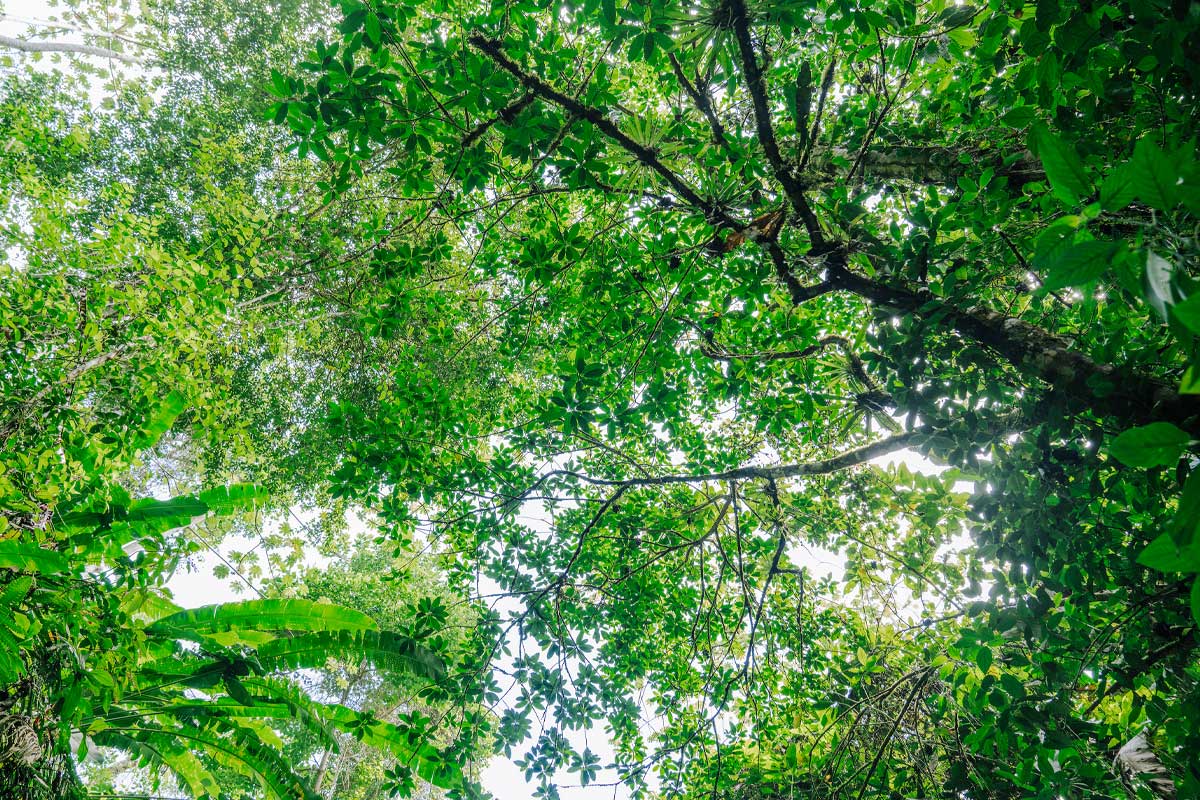
Here at the Asa Wright Nature Centre, we get very excited about Bearded Bellbird sightings in Trinidad. This beloved birdwatcher species also draws science-fanatics and music lovers alike to Asa Wright birdwatching. But how can one little bird do so much? The answer lies in the science of its calls.
Small but Mighty: The Musical Call of the Bearded Bellbird
Measuring just 11 cm, the tiny Bearded Bellbird (Procnias averano) commands attention with one of the most powerful voices in the Neotropical forest. He produces a thunderous, metallic “BONK” that can reach over -45 decibels, with frequencies soaring up to 4,000 Hz. Each call lasts roughly 0.2 seconds yet contains up to four distinct sub-pulses, a rhythmic marvel of natural acoustics. Take a listen here (insert link to loudest bellbird segment.png) and see if you can believe the singer is one of the smallest residents of the eco lodge Asa Wright Nature Center.
From the Bearded Bellbird’s perspective, these calls are meant to attract mates and to assert territory across dense forest landscapes. But as part of Hasco Experience’s conservation and sustainability efforts (link to page), we strive to learn more than the obvious about the living creatures we seek to protect. So, through passive acoustic monitoring and spectrogram analysis, we’ve been documenting these signature calls, revealing the precision, power, and structure of this iconic species.
Below, explore the sonic world of the Bearded Bellbird. Each clip can be paired with visual spectrograms that reveal the rhythm, frequency, and amplitude of the call:
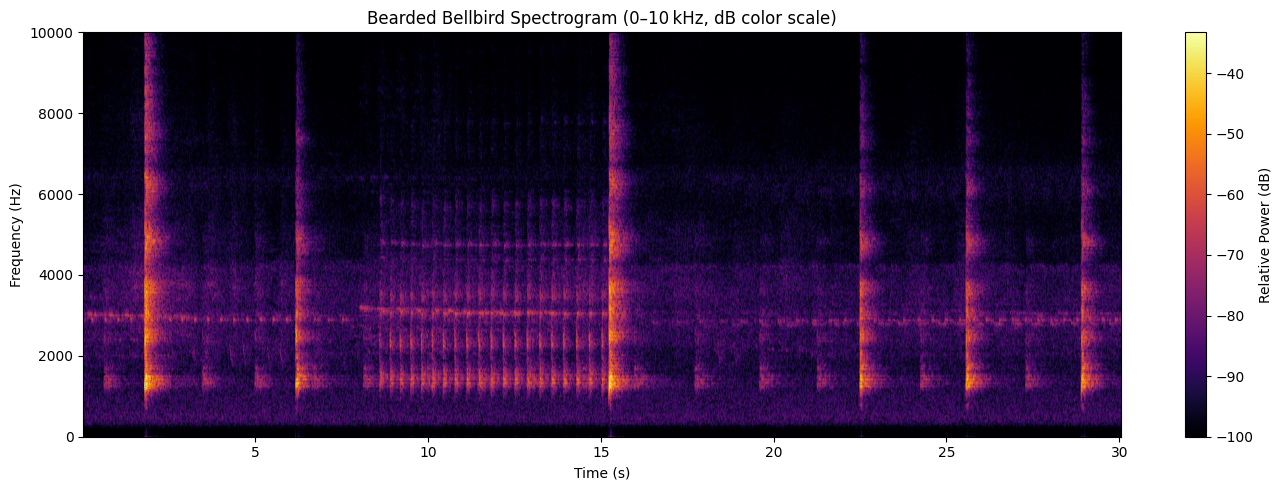
Listen to repeated vocalizations across the 0–10 kHz range, with distinct bursts forming the bellbird’s signature pattern.
[MP3 Placeholder: Zoomed Single Call]
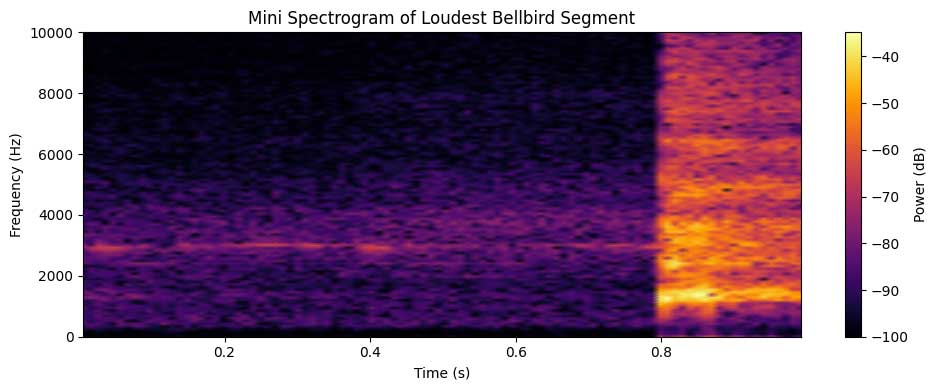
Hear a single call lasting ~0.2 seconds, highlighting the high-intensity sub-pulses.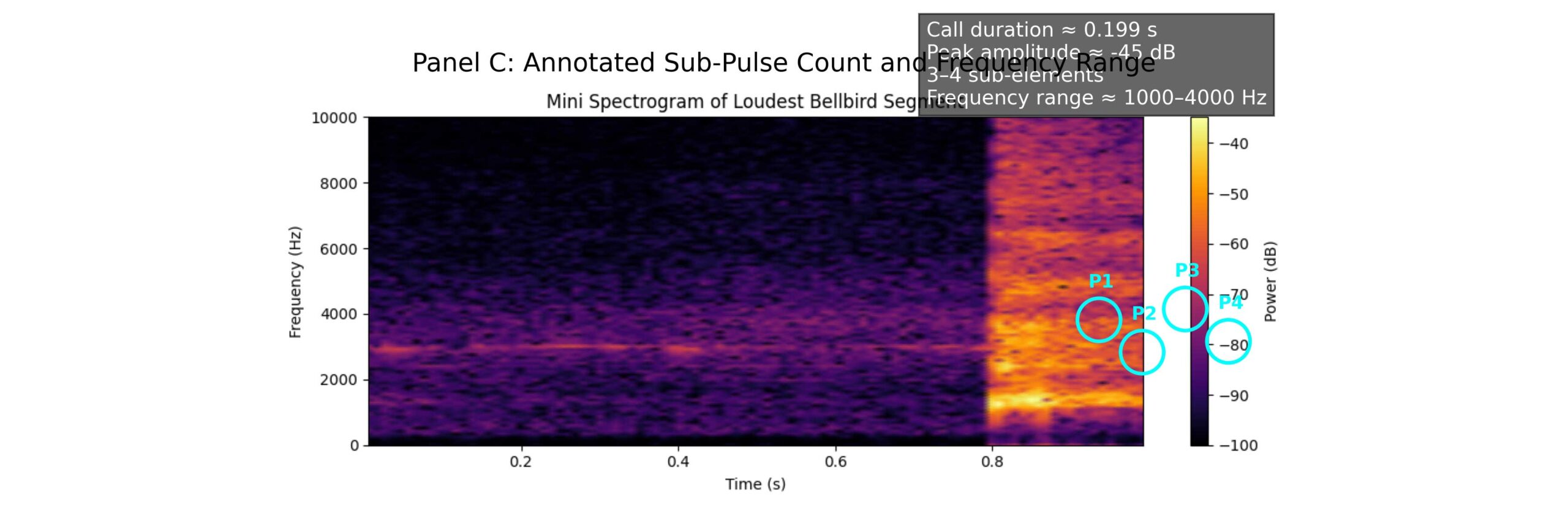
Explore the detailed structure of a single call showing four sub-pulses (P1–P4), with frequency range from ~1000–4000 Hz and duration of ~0.199 seconds.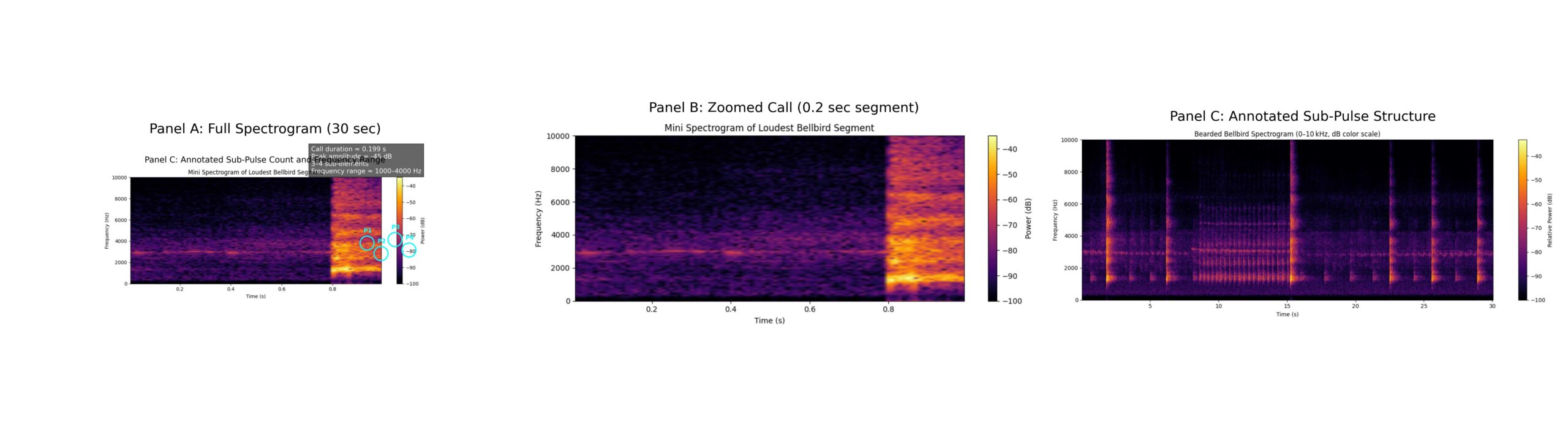
View a multi-panel visualization of Bearded Bellbird vocalizations:
Panel A: Full 30-second spectrogram with repeated calls
Panel B: Zoomed view of the loudest call (~0.2 sec)
Panel C: Annotated call showing 4 sub-pulses, illustrating the rhythmic precision and intensity of the species’ signature note.
See the science behind the sound? At Asa Wright, our guests can not only hear this incredible bird but also explore the science behind its voice. Acoustic spectrograms transform sound into visual art, illustrating the temporal and spectral structure of each call. This allows visitors to appreciate both the beauty of the sound and its role in forest ecology.
Benefits of Birdsong: 5 More Reasons to Hear the Call of Nature
Studies suggest that there are multiple health and wellness benefits that come from listening to singing birds. Now, those benefits can come from simply listening to recordings, so if you haven’t pressed play on the ones we shared above, now is the time to do it. But the real thing is so much better, so we hope you’ll come enjoy our Anima Valley eco-tourism, and enjoy the following benefits of birdsong:
1. Significantly reduce your stress and feelings of anxiety by providing auditory safety cues.
2. Boost your mood, naturally–for up to 8 hours after hearing one little song–as birdsong evokes feelings of happiness and peace.
3. Supports renewed focus and mental clarity
4. Helps manage Seasonal Affective Disorder (SAD)
5. Creates a deeper connection to our natural world
So there you have it: when you go birdwatching in Trinidad, you’ll enjoy more than just sightings of avian and animal life. Thanks to our feathered friends, you can get a concert and a science lesson, while also supporting improved mental health. Sounds like a win you can’t forego? Just check out our tour options [link to activities page] and begin your journey today.